I know it was just a coincidence, but that's an extreme example of what Daniel James' debut novel does to you psychologically. It forces you to question not only the validity of what you are reading, but the reality of the actual events and people that it describes. I was very kindly sent this book by The Bleed magazine and I've been so excited to talk about it since I first picked it up, because it's not a novel you can just leave on your bedside table when you're done with it - you'll think about it all day every day, even after it's long finished.
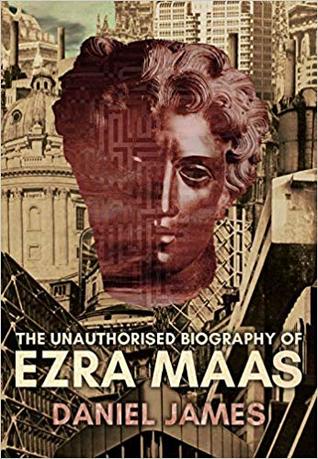
So let's start off explaining what this book actually is. Instantly its structure reminded me of House of Leaves, and if you've read that book then you know what I'm talking about. Ezra Maas opens with an author's note from an anonymous editor explaining how dangerous the novel is. Already, James confronts us with something we are not used to, with the characters in the novel referencing and being aware of the very novel they exist inside. Like House of Leaves' haunting first line, 'This is not for you', Ezra Maas channels the idea of a book as space, its physicality being as important to the text as the plot or characters. This is done well before you even realise it - the title, The Unauthorised Biography of Ezra Maas, is both its fictional and real life title. And of course the word 'biography' already creates confusion in it's immediate suggestion of truth, fact, and real life. This is what James' novel is about at its core - confusing fiction and reality, and fusing the two together to create a haunting and postmodern statement about the fragility of truth.
Ezra Maas is an artist who has gone missing. But he's not just an artist, he's one of the most renowned mysteries of the 20th century. No-one can seem to pin down who he is. He has no past, only rumours of events and beginnings from the people who claimed to know him. Every word about Ezra Maas could be a lie, but there is no way of finding out what is real. Daniel James, the main character of the text but also it's author, attempts to do the impossible and write a biography of Ezra Maas and expose the truth of who he really is. We follow Daniel into a spiral of conspiracies and cults, and into the art world of Ezra Maas. Accompanied by an anonymous editor, who interjects the narrative with footnotes like a parental and trustworthy voice-over, the reader is as much a character as any of the other names in the text. After all, we are reading the very book that is being written about, we hold it in our hands, and thus we weave ourselves into it's tapestry of post-truth and alternative reality.
James describes his novel as an existential noir, but it's also more than that. Halfway through it really began to give me Paul Auster vibes as James turned into a detective who was chasing after a never-ending puzzle without an answer. And like Quinn from The New York Trilogy, James is constantly confronted with himself rather than the man he is chasing. Cities turn into labyrinths with no end point and no way out, and the story takes nihilism head on as we continue to devour the text, long after we've realised there are going to be no answers and no official end to what we are reading. We essentially become roped into James' labyrinth ourselves. What I also loved were James' references to the Tower of Babel and his exploration of language. It is language that both binds and breaks this novel, as the manipulation of it is what creates out distrust of the real. James' ultimate message is that language cannot be trusted, but it is also all that we have.
There are parts of this novel that I really wanted to know more about. I don't know if 'I wanted more' is actually a criticism, but that's my one fault. I wanted to know about Jane, who was taken to a mental institution and died in uncanny circumstances before James could see her; I wanted to know more about the stunt at the end of the book; I wanted to know more about Maas's childhood and his strange psychologist. I really loved the ambiguity of the ending, but I just wanted more information on the steps that were paving the way for James' investigation. I guess it just left me still hungry, which is what a lot of my favourite books have done. Answers are often less satisfying that not knowing, but there was pieces of intriguing information in the middle of the book I would've liked to see more written on.
The Unauthorised Biography of Ezra Maas is a book I'm going to be thinking about for a long time. I really, really loved my time with it and an desperate for other people to read it so I can chat about it with them. This is a clever and addictive piece of postmodernism, taking cues from contemporary horror novels like House of Leaves but also from 20th century texts like The Dice Man and The New York Trilogy. I would highly recommend this novel if you are interested in the ideas of truth vs reality, the postmodern condition, 20th century culture and general mindfuckery that will leave you in crisis when you close the book. This is an astounding debut, with a level of research I haven't seen before in a first novel. I hope James can write another book this compelling, this unique, and this important.

No comments:
Post a Comment